
This post is also available in:
 Italiano (Italian)
TABULA RASA
THE ART OF IMPROVISATION
19 AUGUST / 25 AUGUST
TEACHER
STEFANO BATTAGLIA
Co-produced with Siena Jazz
Attività Polo Musicale Senese
Attività Polo Musicale Senese
GENERAL INFORMATION
The course is open to all instrumentalists, singers, and established ensembles.
PIANO SOLO – Piano class
(max. 6 students / individual lessons of 45 minutes per day)
(max. 6 students / individual lessons of 45 minutes per day)
ENSEMBLE
Open to all instrumentalists and singers
(group lessons of 5 hours per day)
Open to all instrumentalists and singers
(group lessons of 5 hours per day)
All enrolled students will be accepted as active participants. However, attendance on August 18 at 6:00 p.m. is required for an introductory interview with the instructor.
At the time of application, students must attach a curriculum of their studies.
Ensembles that have been established for at least one year may benefit from reduced tuition fees.
Students of Siena Jazz are exempt from the attendance fee (€165).
All students, including Siena Jazz students, are required to pay the registration fee (€48).
All students, including Siena Jazz students, are required to pay the registration fee (€48).
COURSE DETAILS
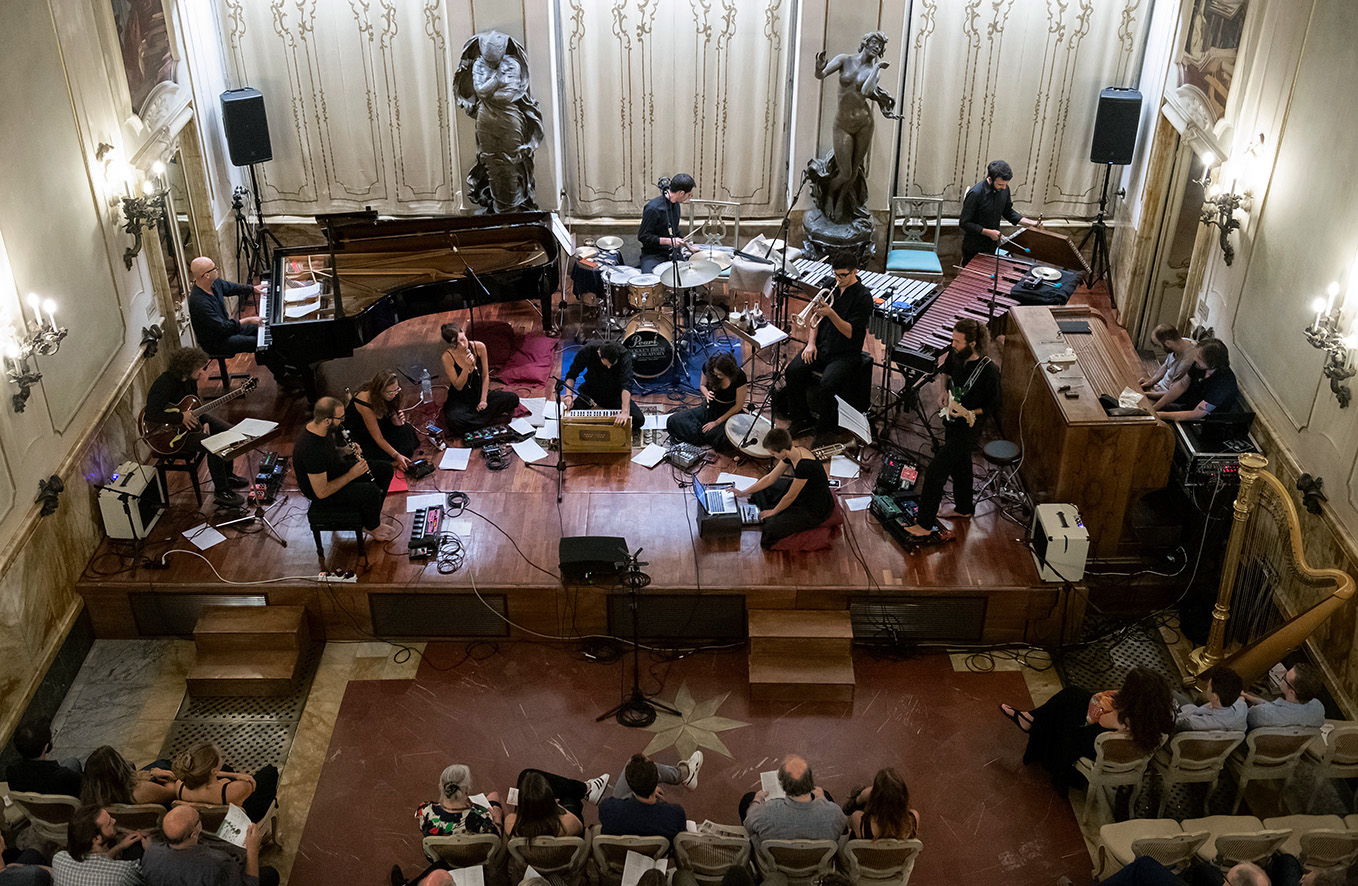
The lessons, workshop-based in nature, are conceived as a research space specifically focused on the practice of improvisation, both within traditional frameworks and in contexts of cross-pollination and new music.
The methodological approach is grounded in direct musical experience, closely connected to instrumental action, compositional techniques, and the widest range of creative and expressive processes, as an alternative and complementary path to conventional educational models based on representation, assimilation, and repetition of styles and models.
This is a performative method designed to accompany musicians through one of the most difficult and decisive phases of their development: those who have chosen music as their profession and art and who require a culturally autonomous environment, free from external pressures, in which to experiment through a continuous experience of rehearsal and research—both individual and collective—leading to a more complex yet joyful, articulated, and conscious musical maturity.
LESSONS AND WORKSHOPS
The lessons will explore the following aspects:
– learning to listen to and recognize musical material: the four parameters
– learning to build and manage the creative process without predetermined models
– deepening the relationship between conscious listening and reaction
– defining different levels of self-resonance and musical perception
– developing a complementary instinct among musicians in instrumental action
– increasing the speed of constructing internal musical balances within the group
– acquiring the ability to recognize, develop, and place thematic figures in dialogue, accompanying narrative subjects and developing them semantically within morphological structures: the three narrative parameters
– learning to build and manage the creative process without predetermined models
– deepening the relationship between conscious listening and reaction
– defining different levels of self-resonance and musical perception
– developing a complementary instinct among musicians in instrumental action
– increasing the speed of constructing internal musical balances within the group
– acquiring the ability to recognize, develop, and place thematic figures in dialogue, accompanying narrative subjects and developing them semantically within morphological structures: the three narrative parameters
Once the learning phase has been completed, the next step will be the construction of a personal artistic identity through an experimental approach to music—an essential and often postponed process for musicians. This research equally encompasses compositional awareness and the expansion of instrumental technical skills.
The research aims to explore the most vital and forward-looking possibilities of the musical universe through instant composition, experimenting with different possible ways of conceiving an improvisational performance.
During the course period, students will also take part in a meeting with Maestro Giancarlo Schiaffini
(“Improvisation Is Not Improvised”).
(“Improvisation Is Not Improvised”).
COURSE BEGINS
19 August / 10.00 am
AGE LIMIT
none
ADMISSION
introductory interview: 18 August (6.00 pm)
APPLICATION DEADLINE
31 JULY
TUITION & FEES
– APPLICATION FEE must be sent to the Accademia Chigiana WHEN YOU SUBMIT THE APPLICATION!
– Course tuition / ATTENDANCE FEE should be paid only after receiving an acceptance letter from the Accademia to the course